This article is a summary of the webinar “Full Analytics in Shopify. Step by Step: From Attribution Setup to a Scalable Data Strategy”.The discussion featured Kamil Borkowski, COO and Co-Founder at Sublime, and Artur Rak, Delivery Manager at attomy.
The full recording of the session is available here!
Executive Summary
The goal of the session was to show how Shopify brands can evolve from basic reports into a connected, data-driven environment – one that enables both speed and precision in decision-making.
The webinar served as a practical guide to building an analytics setup that supports every stage of growth – from initial attribution to advanced retention strategy. Its purpose was to help e-commerce teams create a data foundation that drives fast yet reliable decisions, integrating sales, marketing, and retention insights into one consistent model.
From Intuition to Data
At the beginning of any e-commerce journey, intuition is often your best ally – you have little data, few tools, and you need to move fast. But as budgets grow and marketing channels multiply, so does the cost of mistakes.
“In the beginning, intuition plays an important role – we have little data, few tools and we need to make decisions fast. But as the business grows and the data becomes more fragmented and complex, the role of intuition gets smaller and analytics becomes crucial.” – Kamil Borkowski
This shift – from intuition to data-based decision-making – defines the maturity path of every D2C business. In the early phase, Shopify provides everything a young brand needs: clear reports, customer cohorts, retention metrics and average order values. These indicators are enough to validate product–market fit and get a first sense of what drives revenue.
However, once a business begins to scale, intuition quickly becomes too expensive. That’s the moment when data must take the lead.
Finding the Right Balance: LTV/CAC
As the business grows, one metric becomes absolutely essential – the relationship between lifetime value (LTV) and customer acquisition cost (CAC). It’s the simplest and most effective way to measure the sustainability of marketing spend. Kamil summarised it clearly:
“If the lifetime value to CAC ratio reaches two or three within your payback period, that’s great. If it’s too low, you’re acquiring weak customers. If it’s too high, it means you’re not using all the opportunities to scale.” – Kamil Borkowski
In practice, this means that a healthy business should recover its acquisition costs within a reasonable payback period and then generate profit with each returning purchase. Shopify provides the necessary starting data – revenue, order count, and average basket value,but a true picture of efficiency emerges only when this information is merged with ad-spend and cost data from platforms such as Meta, Google Ads, or TikTok.
The next step is to move from revenue-based to margin-based LTV and align it with CAC by channel. Equally important is separating attribution for new-customer acquisition from retention campaigns. Without that distinction, many brands end up paying CPC for customers who would have come back organically or through cheaper CRM communication. Maintaining an LTV : CAC around two usually signals that acquisition and retention are balanced and the brand is scaling sustainably.
The Power of Knowing Your Customers
While LTV and CAC describe the economics of growth, RFM analysis (Recency, Frequency, Monetary value) shows where analytics turns into action. Shopify includes an RFM report “out of the box,” but its real value appears when brands use it as an activation blueprint, not just a diagnostic view. By identifying segments such as Champions, Active Customers or Previous Loyalists, teams can design personalized strategies for each group instead of relying on broad, inefficient campaigns.
A strong example is the RFM with Your KAYA, where a targeted activation of Previous Loyalists generated a +38% uplift in conversions within the test group – all with a very small media budget.
This illustrates how analytics stops being a reporting layer and becomes an actual growth engine. When marketers know exactly which customers are slipping, which are ready to buy again and which require a different message, they can run smaller, more profitable campaigns with clearly measurable impact.
RFM also bridges marketing and retention. Understanding when customers last purchased, how frequently they buy, and how much they spend helps create communication that matches their lifecycle stage. Instead of over-investing in acquisition, brands can often drive faster and cheaper growth by re-activating the right existing customers — not all of them, just the ones with the highest potential.
The Role of Attribution Models Across the Customer Journey
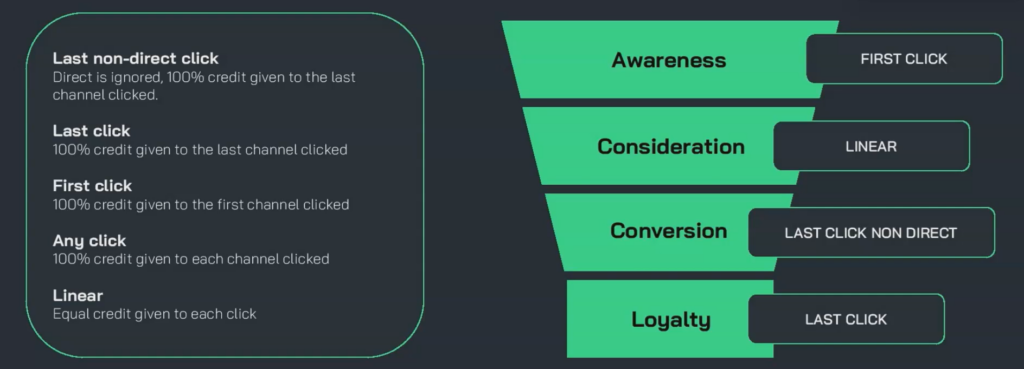
The conversation also covered one of the most misunderstood areas in Shopify analytics – attribution. There is no single “best” model. Each approach serves a specific purpose in the customer journey. The last-click model works well for bottom-funnel activities such as Google Ads or remarketing, while first-click and linear models are better suited for awareness and nurturing campaigns. Shopify’s “any-click” model, available by default, duplicates conversions across all touchpoints to show how many customer journeys each channel influenced – not for comparison, but for understanding contribution.
Attribution is also where many marketers ask the classic question: “Why does Meta perform so poorly in analytics when its own panel shows great results?”
The answer, as discussed in the session, lies in combining Shopify data with Meta’s Graph API and using server-side integrations. Tools like Sublime fill exactly that gap by merging ad costs, click data, and conversion paths into a unified model that restores accuracy and trust in marketing numbers.
Scaling Beyond Intuition
Building mature analytics in Shopify is not about adding more dashboards; it’s about connecting insights into a single, reliable system. Shopify provides a strong foundation for early-stage businesses, but as a brand scales, data needs to flow freely between platforms, channels and costs. Speed without accuracy is intuition. Accuracy without speed is paralysis.
The healthiest businesses know how to balance both. Intuition helps you start, but data lets you scale. Book a free demo and see how Sublime helps Shopify brands uncover the real performance of their channels, recover lost value in customer journeys and scale with clarity, not guesswork.